Be yourself; Everyone else is already taken.
— Oscar Wilde.
This is the first post on my new blog. I’m just getting this new blog going, so stay tuned for more. Subscribe below to get notified when I post new updates.
Be yourself; Everyone else is already taken.
— Oscar Wilde.
This is the first post on my new blog. I’m just getting this new blog going, so stay tuned for more. Subscribe below to get notified when I post new updates.
At first, I was definitely dreading that this class was a writing class. I have never been great at writing and was just taking this class for a general education credit. Thankfully, I do believe that it has helped me in my writing, and even in my reading. In the free writes and a couple of the assignments really got me interested in the subject that I was writing about. Instead of it feeling like an assignment, it was more of a journal. Just being able to put my voice put on paper (or on the computer). It also taught me that you definitely do not need to be formal all the time when writing. You have to formulate who your audience is and then make your piece appealing towards them. I loved the first major paper about our relationship with reading or writing. I just felt that with that assignment, I could just write forever because it was my experience and my voice especially. I think starting off with this assignment got me thinking about how I write and then later on seeing how that improved in blog-assignments like the open letter. I loved how everything was super open, and you could really write about things that we are passionate about.
Well, I learned what rhetoric meant and how to apply it. But I would actually have to say that yes, my writing has improved. After going back to see how my writing style was at the beginning of the semester and before, it was bland and did not really have any important context or rhetoric. I followed the 5-paragraph rule, and it seemed like I was writing to a brick wall. But now, my writing has gotten more aggressive because I want my voice to be heard and appeal to people. Getting straight to the point, therefore, making my argument stronger in fewer words. Writing seems more comfortable and flows better. I have wanted to get back into reading just so I can be better at writing.
Like I said, I now understand what rhetoric is. Before the class started, I texted my friend who is a creative writing major to ask her what this class was. I even asked her what rhetoric was. It still didn’t register after that. But now I do, learning how to formulate your writing to properly persuade your audience, and get them emotionally invested. I feel like that throughout the semester, we had assignments that show us how to use rhetorical devices, and how they are used in different mediums. I loved how you can show rhetoric with pictures to enhance your writing too. That was a fun little addition to any paper.
An assignment that I really enjoyed doing were the Maus I and Maus II readings. I thought it was super creative how Spiegelman used a graphic novel to interview his father about the holocaust. In a way I connected the assignment with our Identity Focus similar to the reading. Although not as intense as Siegelman’s novel, ours was more of an autobiography on what makes us as a person. This in relation shapes who we are as writers. I realized after this assignment I love writing about my family, swimming, and cooking. There are things that I will just gravitate towards as they’re the topics that I feel comfortable with. So that’s what I learned about myself as a writer, I write best with what I want to write.
I really did love this class as it made writing very fun! Thank you for a great (but weird) semester!
To those Facebook Parents who believe that they should not vaccinate their kids because it leads to autism or other medical issues:
How come is it that you are all suddenly becoming doctors on Facebook? Taking opinions to social media and voicing reasons for not vaccinating your children. Some people say, “Oh, they’re too young to make their own decisions; we are just looking out what is best for them.” Even providing articles that once again are either not credible or are just other parents reiterating the statement that you believe in. In the United States, it is not normal to hear about parents opting out of vaccines in fear for their children’s safety. But is it vital to be Dr. WebMD on every social media platform? There is one thing that I have seen many times again, and that is that the MMR vaccine causes autism. It has been proven to be false. However, his statement seemed to be taken to everyone as “all vaccines pose a health risk to people.” But I can attest to you that vaccinating your kids and even yourselves are quite possibly the best thing you can do for health and safety.
First of all, I would like to mention that I have a family member who is autistic. My younger brother got diagnosed when he was two years old. Yes, that did affect my family, knowing that he was going to be different and that some people would treat him differently. Would he be normal? Would he go to college? Would he get a regular job? Could he be on his own? We did not know at the time. Fast forward to today, he is the most kind, incredibly smart, and independent person I know of. He is going to college for Machine Learning and Artificial Intelligence at a school that is essentially the hiring ground of big tech companies like Microsoft, EA, and Apple. He has the biggest heart in the entire world, and his autistic brain is hardwired to have special attachments, so once he decides if he can trust you, he showers you with kindness and love. Now, when people say “I don’t want to risk my child getting autism, so I am not getting my child vaccinated,” that affects other people. Especially who (1) Have autism like my brother and (2) People like me whose entire life has been shaped around a person with autism. You’re saying that you would not want a child that needs your help, love, and affection like any other child, but just slightly different. Why should that be a deciding factor on whether or not you should want to vaccinate your kids? It just boggles my mind in that sense. But I am here to tell you as to why that autism shouldn’t even come to your mind when you say the word “vaccine.”
An article is what started it all. British gastroenterologist Andrew Wakefield published a piece of literature in 1998, describing how eight children showed signs of autism after they had been given the Mumps, Measles, and Rubella Vaccine (MMR). The theory was that the MMR vaccine had cause inflammation in the intestine to which proteins were then released into the bloodstream, leading them to the brain (Gerber). Once it reached the brain, it affects development. There are issues to Wakefield’s study. There was no control group, groups of data not collected completely, gastrointestinal issues were not found in kids that had already previously had the vaccine and autism, the MMR vaccine had shown to not make the intestines inflamed, and these proteins that were supposedly in the bloodstream were never identified. This theory was rejected and proven false. Although it is still being used as a method to get parents to stop vaccinating, sure, this is a man that has credibility, but the findings were incomplete. After this, the study was published, and many people began to research this topic. Again, the theories were rejected. After the accusation, Denmark decided to do a ten-year study on 657,461 children born between 1999 and 2010. As it concluded, there was an incidence rate of 129.7 per 100,000 people. They were taken into account if they had received the MMR shot and family history. After check-ups and constant monitoring of those children that had been given the vaccine, there was no risk for autism, nor does it trigger it (Hviid). After this, you’re probably wondering, what does cause autism?
There is no easier way to say this, autism is genetic. There is no increased risk of your children being diagnosed with autism if they have received a vaccine. It is all in your genes. These genes have been identified as those that affect the function of brain neurons. Parents of kids with autism are shown to exhibit some mild impairments in skills and repetitive behaviors (“Autism Spectrum Disorder Sheet”). My mom and I believe that my dad has some sort of the gene in him as my brother and him essentially have twin personalities. But unless you know that there is someone who has had their genes tested you would not really know if you carried the gene. Not everyone who has the gene, will get autism. It is all a matter of chance. Not the vaccines.
The time you have all been waiting for is why vaccines are good for you. First of all, it is so much easier to prevent a disease rather than to get it and treat it afterwards. So many diseases can be prevented after the first round of vaccinations. When a young child is exposed to a disease that they have not been vaccinated for, it’s a possibility that they would not be strong enough to fight it. Why risk that chance? Why go backwards in time when kids would die from vaccine-preventable diseases? Receiving vaccines provide immunity for both themselves and those in the community who cannot get vaccines due to allergies and other health reasons (CDC). According to the CDC, a vaccine is a safer substitute for a child’s first exposure to a disease. Listen to the CDC on those benefits. Receiving a vaccine is the safest way to fight a disease without actually suffering from it.
In a way would you rather have a child that has autism or an incurable, unpredictable disease that can cost you hundreds of thousands of dollars? So, Facebook parents, next time don’t just think of your child, think of other people. Listen to the facts. Vaccines do not cause autism. Vaccinate your children, and yourself to protect everyone. Also, just be considerate about what you are saying online about vaccines cause autism. There are people out there who have it and they can easily take what you’re saying about vaccines in the wrong way.
Sincerely,
Carina Laukaitis
“Autism Spectrum Disorder Fact Sheet.” National Institute of Neurological Disorders and Stroke, U.S. Department of Health and Human Services, 13 Mar. 2020, http://www.ninds.nih.gov/Disorders/Patient-Caregiver-Education/Fact-Sheets/Autism-Spectrum-Disorder-Fact-Sheet.
CDC. “Vaccines: Vac-Gen/Why Are Childhood Vaccines So Important?” Centers for Disease Control and Prevention, Centers for Disease Control and Prevention, 16 May 2018, http://www.cdc.gov/vaccines/vac-gen/howvpd.htm.
Gerber, Jeffrey S, and Paul A Offit. “Vaccines and Autism: a Tale of Shifting Hypotheses.” Clinical Infectious Diseases : an Official Publication of the Infectious Diseases Society of America, U.S. National Library of Medicine, 15 Feb. 2009, http://www.ncbi.nlm.nih.gov/pmc/articles/PMC2908388/.
Hviid, Anders, et al. “Measles, Mumps, Rubella Vaccination and Autism: A Nationwide Cohort Study.” Annals of Internal Medicine, American College of Physicians, 16 Apr. 2019, annals.org/aim/fullarticle/2727726/measles-mumps-rubella-vaccination-autism-nationwide-cohort-study.
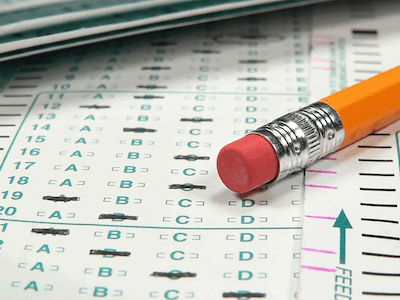
What shows the potential of a student for admission into a college? Well, standardize testing scores, of course! This benchmark test of student readiness for college and provides an idea for colleges that students would be best for their curriculum. The higher the score, the smarter the student, the more colleges want you. Your SAT scores allow you to start thinking about your reach schools, your safety schools, and your average schools. If you do not get excellent SAT scores, you will never get into the best school, which means you won’t get a high paying job after you graduate. It’s simple, study hard for the SAT, get amazing scores and colleges will accept you just on that basis alone. I believe that all colleges should require the use of SAT scores when admitting prospective students as it prepares the student for college life, as well as determines if they would be a good fit for the school itself.
The SAT scores help the college or university place you within their school. Contrary to what people say, the scores matter, and colleges look at these scores to determine admission. Not only do they determine admission, but they use the SAT scores to award scholarships, determine placement within classes, and figure out if they would benefit academic support in college. The scores are not only helping the school out but you as well. It is to supplement your college experience to make it as specialized as possible. The tests realize skills similar to those that you would need in a college classroom. Very high ranked schools like Harvard and Princeton require that students send in thier scores, so other schools should follow what they are doing.
Even these schools saying that they are not requiring SAT scores are influencing people not to take the SAT or other standardized testing. Just the act of taking the SAT opens new doors to the prospective students. Once a student takes the SAT, their name goes out to all of these schools that they would not have even known about if they didn’t take the test. For me, I did not even know half the schools that I applied to before I took the SAT. It brings relief to the student, knowing that there is a school that saw their score and see a future for them at the institution. Taking the SAT is like a right of passage. Everyone has to take it and if you don’t, you could be ruining your chances of even just belonging to an insituttion. So in conclusion, schools need to require SAT scores, as they help schools get a great new class, not requiring SAT scores just make it difficult for both the school and the student.

I believe that Orwell’s vision of the telescreens was very accurate, and it has become a reality in our everyday lives. Technology is everywhere, and it seems that we are never 10 feet away from any sort of technology at any given time. I think our phones are our type of telescreens. But the difference between our telescreens and Winstons telescreens is that they know that Big Brother is listening. They give us the ability to do anything and everything, they have turned from large, bulky, bricks to a slim, portable, miniature computers, having the world at your fingertips. It is also believed that our phones are actually listening to us as targeted ads and recommendations are very similar or exactly what we were thinking about. So, is our government doing exactly what Oceania is doing with the telescreens and just not telling us?
If we knew that our technology was listening to us, I think I would most definitely change my behavior. Even when I have my friends or people who know me, there is this still sense of not being myself. I would probably go crazy if I did not have a little alone time. Changing the way I react to certain things, always feel like I was being watched. When you feel like you are being watched, you feel a sense of those eyes on you, you want to stay quiet and not say anything. I kind of correlate not being alone to being followed. A pair of eyes on you makes you scared, a feeling that you cannot get away fast enough. I would feel more cautious about my everyday life. Being careful what I say and how I say it, just like Winston felt like during work. Have to watch out for those
If we knew that our technology was listening to us, I think I would most definitely change my behavior. Even when I have my friends or people who know me, there is this still sense of not being myself. I would probably go crazy if I did not have a little alone time. Changing the way I react to certain things, always feel like I was being watched. When you feel like you are being watched, you feel a sense of those eyes on you, you want to stay quiet and not say anything. I kind of correlate not being alone to being followed. A pair of eyes on you makes you scared, a feeling that you cannot get away fast enough. I would feel more cautious about my everyday life. Being careful what I say and how I say it, just like Winston felt like during work. Have to watch out for the possibility of thoughtcrime.
A possible advantage of having Big Brother watching was that we would all be in check. Everyone would be cautious about what they were doing, and I feel as if there would be less visible crime. Although the disadvantage of having less visible crime would be that people would have the desire to sneak around and avoid the law. There seems to be counterintuitive considering that the purpose of the telescreens listening to your every movement is that crime would be decreased. Other than crime, having smart technology that gives us personalized content is an advantage. We would not have to waste our time going through things that we would not want to have seen anyways. However, this could also be a disadvantage. Shows such as Black Mirror kind of shows us what smart technology would be like in our day in age and it’s kind of scary. Episodes such as “Crocodile” where an architect has kept a dark secret by killing and is eventually caught because of a special device used to scan memories. Things like that show us the dangers and scenarios of letting people in on our secret lives. In many ways, it can be seen as the show Black Mirror is our generations version of 1984, telling the future.
I believe that we are already monitored enough. I would allow just a little bit more monitoring, but not to the point where it feels like we’re being followed home. Even if the government told us that we would be more monitored, I would still not like knowing. They could do it for the safety of the country, but just dont tell us.
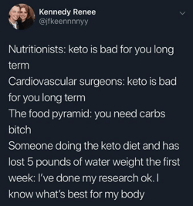
I have decided to analyze an article that I found regarding the Keto diet. This article reviews the popular diet, if it leads to weight loss, and is this diet safe for ordinary people. The keto diet uses the body’s fat-burning system to help people lose a significant amount of weight in a small amount of time. The body will enter a state of ketosis, where ketones will build up in the body. The author, Liz Seegert, is a part of the association of Health Care Journalists, and there are experts such as clinical dieticians weigh in on the safety of this diet.
The author has decided research the keto diet is because it is a trendy topic. Many people see words such as weight loss, fast, and easy, and are drawn immediately to the diet. Losing weight is very hard for some and if they have the option to lose weight fast, they won’t even think twice about trying it even if it’s healthy or not. One of the biggest issues about the Keto diet is that it is not good for your body in the long-run if you are doing it for fun. The article is broken up into five sections, “what ketosis is,” “where it’s helpful,” “when it’s unhealthy,” “the feeding tube approach”, and “how we should not become weight-obsessed.” It is an informing article, persuading the reader that they should do their research and figure out if the diet is right for you. The audience is anyone who wants to try the diet and is unsure if it would be the right choice. It could also be informative to those who are on the diet and need to stop participating because they are harming their bodies. I believe that the most informational and persuasive sections are, “where it’s helpful,” “when it’s unhealthy,” and “how not to be weight-obsessed. “
In the “where it’s helpful” section, there seems to be a lot of sayings negating the diet. The author uses the rhetorical device litotes to show that with all the benefits of the diet, it “would not necessarily improve performance.” For example, the author says that “it [the diet] eliminates a food group, making it easier to follow” and then says it is hard to adhere strictly to the diet. For it to work correctly, you must follow strict guidelines. It also piled on facts about how the keto diet has helped children with refractory epilepsy reducing the number of seizures they have. However, they don’t know how this works or why that is happening. The registered dietician at the Cleveland Clinic Children’s hospital who commonly uses the keto diet for the treatment, says that there is no clear definition of what is happening in their bodies, but uses it anyway. I think that the use of this device is useful because it does show the positives of the keto diet but then discourages those from trying by showing that there are uncertainties and difficulties.
In the “When it’s unhealthy” section of this article, the most effective sentence says how the keto diet should only be considered in extreme cases and how people are only using it for cosmetic reasons, making it dangerous. Once your body moves into ketosis, you will start to lose fat, muscle, and feel extremely fatigued. The end of this cycle puts your body into starvation mode. The diction is what makes this section of the article useful. It is meant to scare the audience into only trying the keto diet in extreme cases. Words such as starvation, caution, extreme, damage, and sensitivity will trigger an emotional response to the readers, scaring them into rethinking as to why they are interested in the diet. The doctors in the article mention that the keto diet can be beneficial to cancer patients, and those with type 2 diabetes to improve insulin sensibility. So, by using scare tactics, the author is trying to convince the reader to do the keto diet only if it benefits their health, not their weight.
The last section of the article sympathizes with the reader asking if they are considering the keto diet because they are obsessed losing weight or if they need it to regulate something in their body. Marketing this diet to a society that is obsessed with losing weight is good. These “fad” diets are not healthy for us in the long run. The use of the rhetorical device eutrepismus makes the audience assess any diet on their own. You set realistic personal goals by evaluating the diet plan. First, is the diet good in the long term, second, does it include exercise, and third, will it meet your long-term health goals. If you take this assessment to the keto diet, you will find that for many people doing it, will say no to all, which is a red flag. This use of eutrepismus structured the questions in a way that the reader would think about different diets and find the best one that suits their lifestyle. Overall, I believe that this article is effective in getting through to the audiences. I am a firm believer that the keto diet is unhealthy for people doing it to lose weight. A large amount of fat can be dangerous, and this keto diet takes that to an extreme cutting out fat completely. This article has convinced me that in some cases, the keto diet can be beneficial to those who need it. I did not believe that this diet was good for anyone at this point, but this article has convinced me that regarding diets, we need to assess our personal needs to find the lifestyle best for us.
I absolutely despise being told what to do. When you are younger, your parents are your lifeline. They inform you what the difference between right and wrong is, how to take care of yourself, and make sure you eat correctly. Most importantly, encourage you in all your decision making. They try to do this all while not directly forcing you. When I was younger, you had to bribe me to do things. For example, I would only eat my vegetables if I could stay up an extra fifteen minutes that night. Of course, my parents were as stubborn as I was, never taking “no” for an answer. They would always switch things around me and say something like, “If you don’t finish your vegetables, you have to go to bed fifteen minutes early.” But the bribing went beyond food and chores as there was one thing that I never liked to do; read. I hated being told to read. I remember being a rambunctious, full of energy kid, and never sitting down and reading a book. In particular, books that I did not find interesting or the ones that I was forced to read for school. That brings me back to being told what to do. When I was told to sit down and read a book picked out by someone, I did not want to do it. Of course, I would sit there quietly and pretend to read the assigned book, but in reality, I would sit there, wishing I could do something else. There was also one person that always tried to get me to read, even bribing me to do it because he wanted me to love books as he did, and that was my dad.
My dad is the smartest person that I think I’ll ever know. He as a kid loved books and to this day says that the reason he became a doctor is that he loved to read and get to keep doing it. I am still confused as to why being a doctor and reading correlates but I just let him have it. Growing up I would be surrounded by books of all genres. In my dad’s library, he would have books that were medical, real estate, “make money fast,” entrepreneurship, mystery, fiction, cookbooks, etc. Anytime that he would finish a book it would go straight into the library. The library to this day is so full that I don’t think I have stepped foot in that room in a year because you cannot open the doors.
One summer, my dad told me that he wanted me to read more. He and I made a deal that if I read 100 books of his choice before school started, I would get a prize. This got my attention because I was getting something out of it and that I was not being forced to do it. My mischievous brain was coming up with a plan that I could trick my dad into thinking that I read the books without actually reading them. I felt that I could flip through reading a couple of pages, in the beginning, middle, and end, and then tell him the summary like that. To my dismay, my dad caught on to what I was doing, so then he forced me to sit down and read next to him in his library. Here we go again, doing what I hated, being forced. But you know that sort of thing made me actually sit down and read. We would sit in the musty library with the sun shining through the big windows. In the sun rays, you could see the dust particles floating in the air. Gross, but in a way that was super calming to me. That summer, I want to say that I read with my dad every single day. At one point, I ended up not feeling forced to read. It felt like I was spending time with my dad.
As I got older, again, anytime that I was forced to read something, I would never do it. My dad would still give me books to read but without the incentive of a prize. He would be like, “Carina, I just finished this book, and I think you would really like it,” and then I would set it aside, and I would never pick it up again. This was going back to the fact that I was being told to read the book. Like someone assuming that I would like it. I wanted to read on my own terms. I only read mystery books, at one point, I got interested in these donut shop mysteries that had donut recipes in between the chapters. That was all that I would read. Those books were something that I personally was interested in, and no one told me to read them. I still did not read books that I was given, so I never had a deep connection with reading. After that summer of reading, I did not continue to spend time reading books with my dad, but I wished it did. Maybe continuing would bloom into me loving books. Still, I wouldn’t say I like being told what to do by people, but my dad forcing me to read with him for that single summer changed the way that I looked at reading. I never had to be bribed after that with prizes for doing something I already should have been doing. I still do not like being told to read the books that he gives me, but I do try to make an effort. I do not hate reading. I do not love reading. I have a healthy relationship with books, but I never will love books the way my dad does. But that summer of him forcing me to read a hundred books made me hate reading, and people telling me what to do, a lot less.
To my best friend: You know how we always would joke about just quitting swimming? Just flat out walking out of practice and not looking back? Without thinking the other day, I saw the set and just flat out thought in my head “no” and grabbed my stuff and left. I literally have no idea why I did it I just kind of snapped and realized that I had absolutely no desire to swim anymore. I know you kind of went through the same thing and wanted to get your opinion on it. Like I don’t know what I’m going to do, I might try to talk to coach and see what happens if I quit, but he hasn’t reached out to me, so I don’t know if it’s worth it. Can’t I just walk away without receiving any consequences? I do know that if I go back today, he will give me a set of 4×200’s fly for leaving the pool deck. Anyways, if you have any advice on if I should go back and help me figure out my rationale for this situation please let me know.
To my parents: I just wanted to bring to your attention that the other day I did walk out of my practice fully intending to quit. After 10 years of swimming competitively, my heart was not in it anymore. I realized that I needed a break. I grabbed my gear bag and waterbottle and walked right back into the locker room. I have not been back to the pool in three days. I am not quite sure if I will be going back to swimming, however, I am planning to reach out to the coach and will ask him to meet with me. I hope you can accept my decision on what I choose to do. Swimming is still an important part of my life, but in that moment I had no desire to do the set given to me. I know you will support me with whatever I do, and will let you know what happens once I speak to the coach.
To my coach: Hello Coach, I just would like to apologize to you and the team regarding my actions the other day of walking out of practice. I would like to set up a time to discuss why I decided to leave without notice. I was also hoping to figure out a course of action after this situation. I am having trouble deciding if I would like to continue my swimming career and was hoping that you could give me some advice and direction. If you are willing to meet with me please let me know and again, I am very sorry for leaving practice without notice.
This is an example post, originally published as part of Blogging University. Enroll in one of our ten programs, and start your blog right.
You’re going to publish a post today. Don’t worry about how your blog looks. Don’t worry if you haven’t given it a name yet, or you’re feeling overwhelmed. Just click the “New Post” button, and tell us why you’re here.
Why do this?
The post can be short or long, a personal intro to your life or a bloggy mission statement, a manifesto for the future or a simple outline of your the types of things you hope to publish.
To help you get started, here are a few questions:
You’re not locked into any of this; one of the wonderful things about blogs is how they constantly evolve as we learn, grow, and interact with one another — but it’s good to know where and why you started, and articulating your goals may just give you a few other post ideas.
Can’t think how to get started? Just write the first thing that pops into your head. Anne Lamott, author of a book on writing we love, says that you need to give yourself permission to write a “crappy first draft”. Anne makes a great point — just start writing, and worry about editing it later.
When you’re ready to publish, give your post three to five tags that describe your blog’s focus — writing, photography, fiction, parenting, food, cars, movies, sports, whatever. These tags will help others who care about your topics find you in the Reader. Make sure one of the tags is “zerotohero,” so other new bloggers can find you, too.

 carina laukaitis